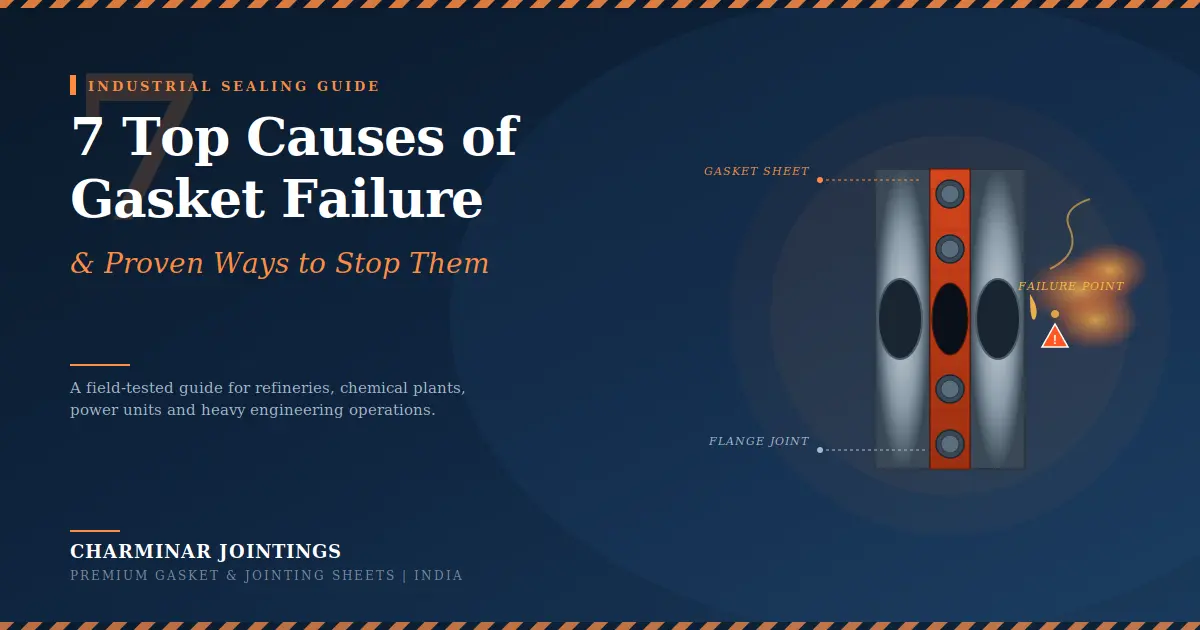
In any process plant, a single leaking flange can shut down an entire production line, trigger safety incidents, and cost lakhs in downtime.
Behind almost every one of these incidents lies a quiet culprit, a failed gasket. Understanding the real Causes of Gasket Failure is the first step toward building leak-free, reliable, and safer industrial systems.
As one of the largest gasket sheet manufacturers in India, we have studied the Causes of Gasket Failure across refineries, fertilizer units, power plants, and chemical facilities for over two decades. This guide breaks down the seven biggest reasons and shows you exactly how to prevent each one.
Table of Contents
What Is Gasket Failure and Why It Matters
Gasket failure happens when the sealing element between two flanges loses its ability to hold pressure, contain media, or maintain its mechanical integrity. The result is leakage, sometimes a slow weep, sometimes a sudden blowout.
In sectors like oil and gas, refineries, fertilizer plants, and pharmaceutical manufacturing, even a minor leak can mean fire hazards, contamination, fines from pollution boards, or unplanned shutdowns.
The truth most plant engineers already know is this: gaskets rarely fail on their own. They fail because something around them — the installation, the material, the flange, or the operating condition — was not right.
According to engineering principles documented in the Wikipedia entry on gaskets, the sealing performance of any gasket depends on the balance between bolt load, material compressibility, and operating media. Identifying that imbalance is what separates a reactive maintenance team from a proactive one, and is at the heart of investigating the real Causes of Gasket Failure.
7 Top Causes of Gasket Failure in Industrial Operations
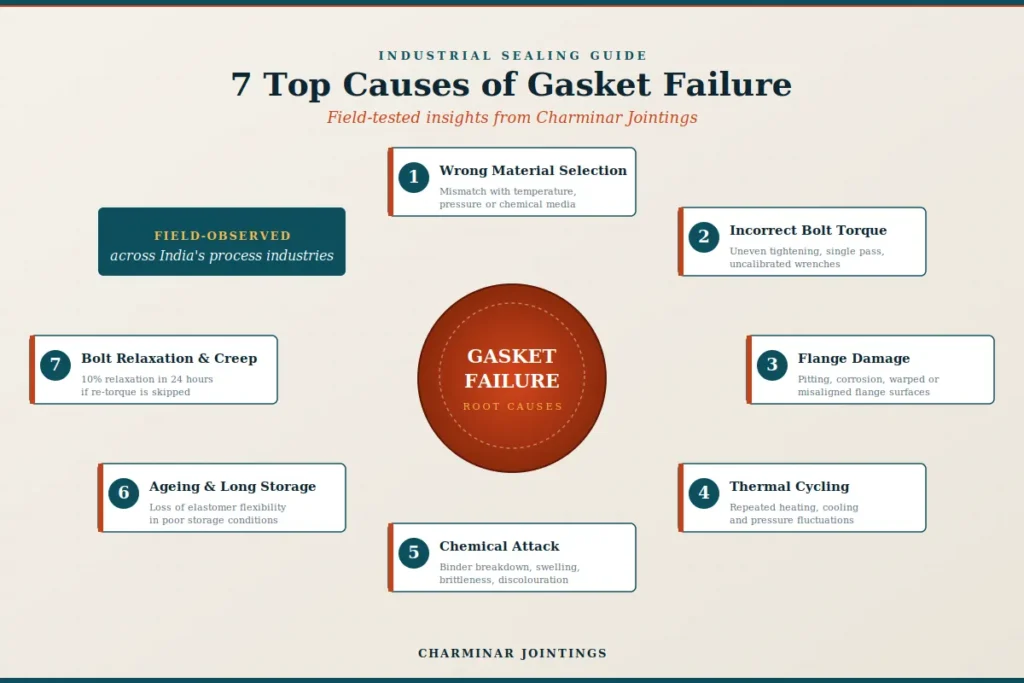
Let us walk through the most common Causes of Gasket Failure that we see across real industrial environments, based on field observations and root-cause analyses we have supported over the years.
1. Improper Gasket Material Selection — A Leading Cause of Gasket Failure
The single biggest reason for premature gasket failure is choosing a sealing material that simply was not designed for the job.
A gasket rated for 200°C will not survive a 350°C steam line. A standard non-asbestos sheet will degrade fast against concentrated sulphuric acid.
Many such Causes of Gasket Failure trace back to procurement teams ordering based on price or habit, rather than matching the material to the actual operating temperature, pressure, and chemical media. Always cross-check against a verified chemical resistance chart before specifying.
2. Incorrect Installation and Bolt Torque
Even the finest jointing sheet will fail if it is bolted down incorrectly.
Common installation mistakes include uneven bolt tightening, skipping the crisscross torque pattern, using uncalibrated wrenches, and finishing in a single pass instead of three.
Under-torqued bolts leave the gasket loose and prone to leakage; over-torqued bolts crush the fibres and destroy the gasket’s recovery ability. Both are well-documented Causes of Gasket Failure that surface within the first few weeks of operation.
3. Flange Surface Damage and Misalignment
The flange face matters as much as the gasket itself. Pitting, corrosion, scratches, warped surfaces, or uneven roughness create micro-channels through which media escapes.
Misaligned flanges put one side of the gasket under heavy load while the other remains barely compressed. This uneven loading is one of the most under-diagnosed Causes of Gasket Failure in older plants, and it cannot be fixed by simply changing the gasket.
4. Thermal Cycling and Pressure Fluctuations
Industrial systems rarely run at a single steady state. Start-ups, shutdowns, batch processes, and emergency trips put the gasket through repeated expansion and contraction.
Over time, this thermal cycling causes the material to lose elasticity, harden, and develop micro-cracks.
Sudden pressure spikes from water hammer or compressor surges can blow out a weakened gasket in a single event, making them among the most violent Causes of Gasket Failure recorded in process industries.
5. Chemical Attack and Corrosive Media
When a gasket is exposed to a chemical it cannot resist, the binder breaks down first, followed by the fibre matrix. Visible signs include swelling, softening, discolouration, and brittle edges.
This is especially common in chemical plants where media composition changes during process upsets. Industry reports published by Reuters on industrial chemical safety highlight how chemical exposure remains one of the most overlooked Causes of Gasket Failure across global manufacturing facilities.
6. Ageing and Long Storage Times
Gasket sheets are not immortal. Even unused sheets lose elastomer flexibility if stored in hot, humid, or sunlit warehouses for years.
Installing an old, dried-out sheet is almost the same as installing a pre-failed gasket. First-in-first-out stock rotation and proper climate-controlled storage prevent storage-related Causes of Gasket Failure and extend usable life significantly.
7. Bolt Relaxation and Creep
After installation, bolts naturally relax by roughly 10 percent in the first 24 hours, and the gasket itself undergoes a small amount of creep.
Without a re-torque pass, the joint slowly loses its sealing stress and begins to weep. Plants that skip the re-torque step almost always experience early flange leaks, making bolt relaxation one of the most preventable Causes of Gasket Failure in the entire list.
Warning Signs Linked to Causes of Gasket Failure
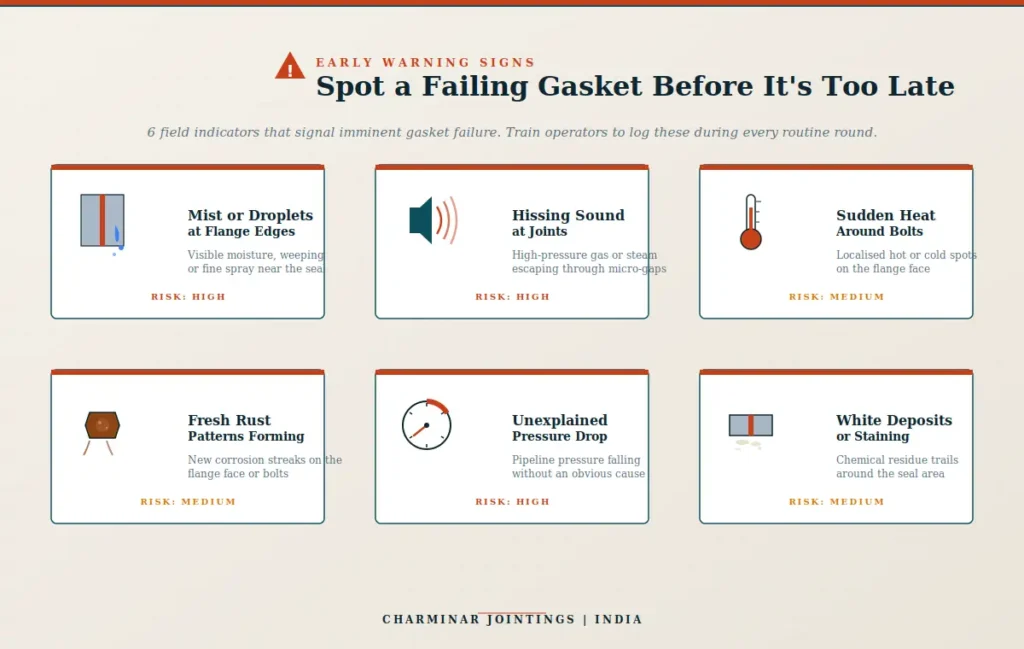
Catching a failing gasket early can save crores in damage. Watch for these field indicators that often appear before complete Causes of Gasket Failure surface:
- Visible mist or droplets near flange edges
- Hissing sounds at joints
- Sudden temperature changes around the bolts
- Fresh rust patterns on flange faces
- Unexplained pressure drops in pipelines
- White deposits or staining around the seal
Train operators and maintenance technicians to log these signs during routine rounds rather than waiting for the next shutdown.
How to Prevent Causes of Gasket Failure: Proven Best Practices
Preventing the Causes of Gasket Failure is not about a single perfect gasket; it is about a disciplined system.
Start with proper material selection guided by actual operating data, not assumptions. Clean and inspect flange faces before every installation, replacing or machining damaged surfaces.
Use calibrated torque wrenches and follow a documented bolt-tightening sequence in at least three progressive passes — typically 30 percent, 60 percent, and 100 percent of final torque, applied in a crisscross pattern.
Always perform a 24-hour re-torque on critical joints. Lubricate bolt threads and nut bearing surfaces, but never the gasket itself.
Maintain a structured inspection schedule for high-risk lines, and document every gasket change with material grade, batch number, and torque value.

Choosing the Right Gasket Material for Long-Term Reliability
Material is destiny when it comes to sealing.
Compressed non-asbestos jointing sheets work well for most general-duty applications across oil, gas, and water service. For higher temperatures or aggressive chemical exposure, wire-reinforced or metallic jointing sheets provide added structural support.
Beater addition and cellulose fibre gasket materials excel where flange surfaces are slightly uneven and require higher conformability.
You can explore our full range of industrial jointing sheets and gasket products to find a solution engineered to neutralise the most common Causes of Gasket Failure in your specific service.
Why Causes of Gasket Failure Are Often Linked to Supplier Quality
The quality of your gasket sheet directly determines how long your joint stays leak-free.
Many recurring Causes of Gasket Failure can be traced back to inconsistent fibre composition, poor thickness tolerance, or unverified chemical resistance from the original supplier.
Working with a reputed Indian manufacturer means you receive validated material data, batch traceability, and technical support during selection.
At Charminar Jointings, every sheet is manufactured under ISO-certified controls, tested against international benchmarks, and supported by a detailed chemical resistance chart that helps engineers match material to application with confidence.
To get a custom recommendation for your plant, contact our technical team directly. With over two decades of experience supplying refineries, chemical plants, power producers, and heavy engineering OEMs, we help plants eliminate the Causes of Gasket Failure permanently rather than reactively.
Frequently Asked Questions (FAQs) on Causes of Gasket Failure
Q1. What are the most common Causes of Gasket Failure in Indian industrial plants?
The most common Causes of Gasket Failure are incorrect installation (particularly uneven or inadequate bolt torque), wrong material selection for the operating temperature and chemical media, and damaged or misaligned flange surfaces.
Q2. How often should industrial gaskets be inspected to avoid Causes of Gasket Failure?
High-risk flange joints in refineries, chemical plants, and steam lines should be visually inspected during every routine maintenance round, with detailed inspection during each scheduled shutdown.
Q3. Can a non-asbestos jointing sheet handle high temperatures and chemicals?
Yes, premium non-asbestos compressed jointing sheets from established manufacturers are engineered to handle a wide range of temperatures, pressures, and aggressive chemicals when correctly specified.
Q4. Should bolts be re-torqued after gasket installation?
Yes, a re-torque after 24 hours of operation is strongly recommended for critical service joints because bolt relaxation and gasket creep reduce sealing stress in the first day, and this single step prevents many Causes of Gasket Failure.
Q5. How can I select the right gasket sheet to avoid Causes of Gasket Failure?
Evaluate operating temperature, pressure, media composition, flange condition, and required service life together, and consult a trusted manufacturer’s chemical resistance chart or technical team before finalizing your gasket grade.
Final Word: Understanding the real Causes of Gasket Failure transforms maintenance from firefighting into prevention. With the right material, correct installation, and a reliable manufacturing partner, your plant can achieve significantly longer joint life, fewer unplanned shutdowns, and a safer working environment.
Connect with Charminar Jointings to find the perfect gasket sheet solution engineered for your specific industrial application.