
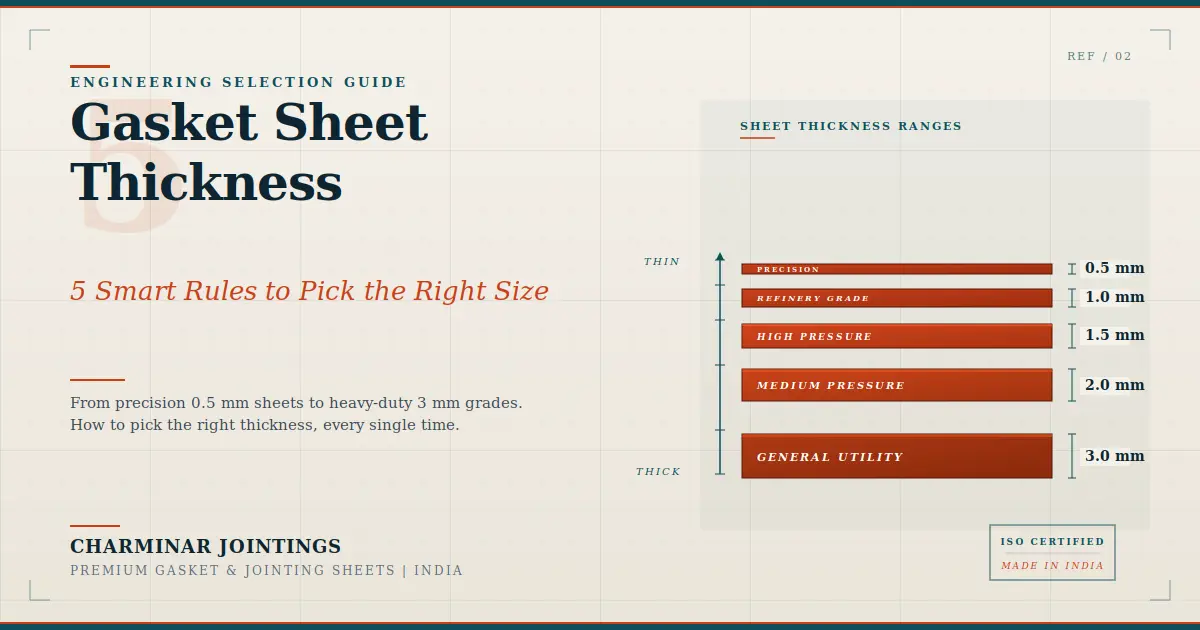
Ask ten plant engineers what Gasket Sheet Thickness they use, and you will probably get ten different answers. Some swear by a thick 3 mm sheet because it conforms to old, pitted flanges. Others insist that a thin 1 mm sheet always seals better and lasts longer. The truth, as we have learned over two decades of supplying refineries, fertilizer plants, and chemical units across India, is that the right Gasket Sheet Thickness depends almost entirely on the flange you are actually dealing with. This guide breaks down five smart rules to choose the correct thickness without guesswork, so your joints stay leak-free for years rather than weeks.
Table of Contents
Why Gasket Sheet Thickness Matters More Than You Think
Most engineers focus on gasket material — the fibre composition, the binder, the chemical resistance — and almost treat thickness as an afterthought. That is a mistake. The Gasket Sheet Thickness directly affects how much the sheet compresses, how much sealing stress it can hold, how it behaves under thermal cycles, and how likely it is to blow out under sudden pressure. A perfectly chosen material installed at the wrong thickness will still leak. A modest material at the right thickness can outperform an expensive one chosen blindly.
In simple terms, Gasket Sheet Thickness controls two competing things: the ability to fill flange imperfections and the ability to resist blowout, creep, and relaxation. According to the engineering principles outlined in the Wikipedia entry on gaskets, the sealing performance of any gasket depends on how compressive load, material properties, and operating media interact at the joint. Get that balance wrong and you spend the rest of the year chasing leaks during every shutdown.
Common Gasket Sheet Thickness Ranges and Where They Fit
Across Indian industries, jointing sheets are typically supplied in a few standard Gasket Sheet Thickness ranges. Knowing where each one fits saves a lot of trial and error during procurement.
0.5 mm Gasket Sheet Thickness for Precision Applications
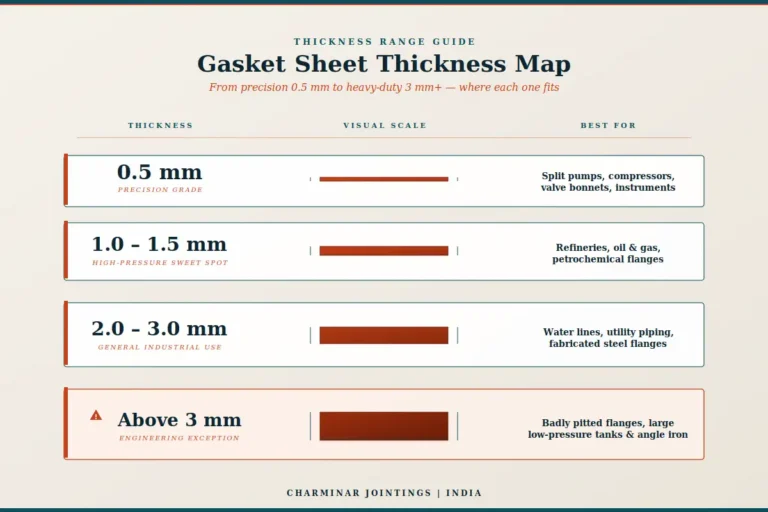
These ultra-thin sheets are used in split pumps, compressors, valve bonnets, and instrument fittings where the final assembled clearance is critical. Tight tolerance, low creep, and consistent Gasket Sheet Thickness across the sheet matter more than conformability here.
1.0 mm to 1.5 mm Sheets for High-Pressure Service
This is the sweet spot for most high-pressure refinery, oil and gas, and petrochemical flanges. Thinner Gasket Sheet Thickness handles pressure better, resists blowout, loses less torque to creep, and seals at lower leak rates. If your flanges are in good condition and the bolt load is adequate, always lean toward this range.
2.0 mm and 3.0 mm Sheets for General Industrial Use
The most commonly ordered Gasket Sheet Thickness in Indian plants — the 3.0 mm sheet in particular — is the workhorse for water lines, low to medium pressure utility piping, fabricated steel flanges, and equipment with less-than-perfect sealing surfaces. They forgive small imperfections that thinner sheets cannot.
Above 3 mm Sheets for Damaged or Large-Diameter Flanges
Sheets thicker than 3 mm should be considered an engineering exception, not a default Gasket Sheet Thickness. They are useful for very large diameter, low pressure tanks, badly pitted flanges that cannot be machined, or angle iron and fabricated steel flanges that distort under bolt load. Use them deliberately, not casually.
5 Key Factors That Decide the Right Gasket Sheet Thickness
There is no universal formula, but there is a clear checklist. Walk through these five factors before placing any Gasket Sheet Thickness order.

1. Flange Surface Condition and Roughness
As a rough working rule, the gasket should be roughly four times thicker than the deepest surface imperfection on your flange face. New, machined flanges with a fine finish seal beautifully with thin sheets. Old, pitted, or warped flanges need extra Gasket Sheet Thickness to fill those gaps.
2. Operating Pressure of the System
Higher pressure systems demand thinner gasket sheets. The reason is simple physics — a thinner sheet exposes less surface area to the internal medium, drastically reducing the risk of blowout. For steam lines, hydrocarbon service, and high-pressure chemical lines, stay between 1 mm and 1.5 mm wherever possible.
3. Operating Temperature and Thermal Cycling
Thicker sheets relax more under heat. After a few cycles, a 3 mm sheet can lose noticeably more sealing stress than a 1 mm sheet under the same bolt load. For lines that see frequent heating and cooling, a thinner Gasket Sheet Thickness retains bolt torque much better.
4. Available Bolt Load and Flange Stiffness
Robust forged flanges with many bolts produce high, even compressive load and seal well with thin sheets. Light fabricated flanges with limited bolts distort under tightening and need a thicker, more compressible Gasket Sheet Thickness to bridge the gap that forms between bolts.
5. Media Type and Permeability Requirements
Hazardous gases, hydrocarbons, and volatile chemicals demand the lowest leak rate possible, which means thinner sheets and tight bolt control. Industry reports tracked by Reuters on industrial sustainability consistently highlight how fugitive emissions from poorly sealed joints remain a major compliance concern globally. For water service, neutral liquids, or low-risk utility lines, thicker sheets are perfectly acceptable and often more forgiving in field conditions.
5 Key Factors That Decide the Right Gasket Sheet Thickness
Choose a thinner Gasket Sheet Thickness — typically 1.0 mm or 1.5 mm — when any of the following apply:
- Flange faces are new, machined, and well finished
- Operating pressure is medium to high
- Bolt count and bolt grade provide strong, even clamping
- System is exposed to thermal cycling or temperature swings
- You need to minimize fugitive emissions or product loss
- The application demands tight torque retention over long service periods
Thinner sheets give you better blowout resistance, lower creep, less relaxation, and lower leakage rates. Most refinery, petrochemical, and high-pressure chemical applications fall into this category.
When Thicker Gasket Sheet Thickness Makes More Sense
There are real-world situations where a thicker Gasket Sheet Thickness of 2 mm or 3 mm is the correct engineering choice, not a compromise:
- Flange faces are pitted, corroded, or visibly uneven and cannot be machined before shutdown ends
- The flange is a large diameter, low-pressure design with limited bolts
- Fabricated or angle-iron flanges that distort under bolt tightening
- Internal pressure is low, so blowout risk is minimal
- Utility, water, drain, or vent lines where simplicity and conformability matter more than absolute leak rate
Used in the right place, a thick sheet seals a difficult joint that a thin sheet would never seal. Used in the wrong place, it relaxes, leaks, and forces a repeat job.
Common Mistakes in Gasket Sheet Thickness Selection
Over the years, we have seen the same handful of Gasket Sheet Thickness mistakes repeated across plants, large and small. Knowing them is half the prevention.
- Using a 3 mm sheet everywhere as a default, even on tight, high-pressure refinery flanges
- Choosing thickness based on what was in stock, rather than what the application needs
- Ignoring flange condition and blaming the gasket every time a joint leaks
- Stacking two thinner sheets together to make a thicker one — almost guaranteed to leak between layers
- Reusing a previously compressed sheet because it looks fine on the outside
- Not recalculating torque when changing from a 3 mm to a 1.5 mm sheet on the same flange
Each one of these is fixable with a small process change and a quick conversation with your gasket supplier before ordering.
How Charminar Jointings Helps You Get Gasket Sheet Thickness Right
At Charminar Jointings, we manufacture gasket sheets and industrial jointing sheets in a wide range of Gasket Sheet Thickness options, from precision 0.5 mm sheets for valves and pumps right through to thicker grades for utility and large diameter service. Every sheet is produced under ISO-certified controls, with tight thickness tolerances, consistent fibre dispersion, and full batch traceability.
You can explore our complete range of industrial jointing sheets and gasket products to find the exact specification for your service. Our HNA series of compressed non-asbestos jointing sheets, beater addition and cellulose fibre grades, and wire-reinforced sheets cover virtually every flange application across oil and gas, refineries, fertilizer plants, power, chemicals, and heavy engineering.
More importantly, our technical team helps you match the right grade and Gasket Sheet Thickness to your actual operating conditions, supported by a detailed chemical resistance chart and decades of field experience. To get a custom recommendation for your plant, contact our technical team directly. The result is fewer leaks, longer joint life, lower maintenance cost, and safer plants.
Frequently Asked Questions (FAQs) on Gasket Sheet Thickness
Q1. What is the most commonly used Gasket Sheet Thickness in Indian industries?
The 3.0 mm Gasket Sheet Thickness is the most commonly ordered across Indian plants, mainly for general utility and medium-pressure service. However, refineries, petrochemical units, and high-pressure systems increasingly prefer 1.5 mm sheets for better sealing performance.
Q2. Is a thicker Gasket Sheet Thickness always better for sealing?
No. Thicker sheets help only when flange faces are damaged, uneven, or under low pressure. In high-pressure and high-temperature systems, thinner Gasket Sheet Thickness actually seals better because it resists blowout and loses less torque to creep and relaxation.
Q3. Can I stack two thin sheets to achieve a higher Gasket Sheet Thickness?
No, this is one of the most common installation mistakes. Stacked sheets create a leak path between the two layers and almost always fail. Always use a single sheet of the correct Gasket Sheet Thickness.
Q4. How do I decide between 1.5 mm and 3 mm Gasket Sheet Thickness?
Check the condition of your flange faces, the operating pressure, and the available bolt load. New machined flanges with high pressure call for 1.5 mm. Older fabricated or pitted flanges with low pressure are better suited to 3 mm.
Q5. Does Charminar Jointings supply custom Gasket Sheet Thickness options?
Yes. Charminar Jointings manufactures jointing sheets in a wide range of standard and customized Gasket Sheet Thickness specifications to suit specific industrial applications. Our technical team can recommend the right thickness based on your flange details and service conditions.
Final Word: Selecting the correct Gasket Sheet Thickness is not a guessing game — it is a balance between flange condition, operating pressure, temperature, bolt load, and media. Get it right and your joints stay leak-free through years of service. Get it wrong and no amount of premium material can save the seal. For application-specific recommendations and high-performance industrial jointing sheets, connect with the technical team at Charminar Jointings — your trusted gasket sheet manufacturer in India.


