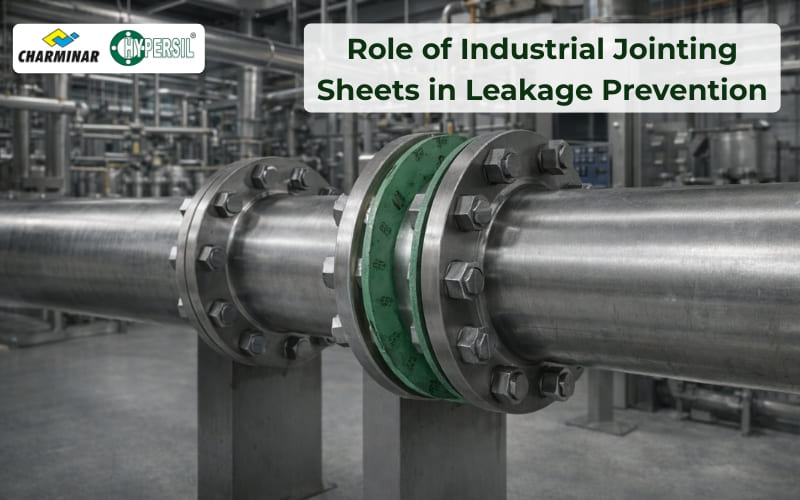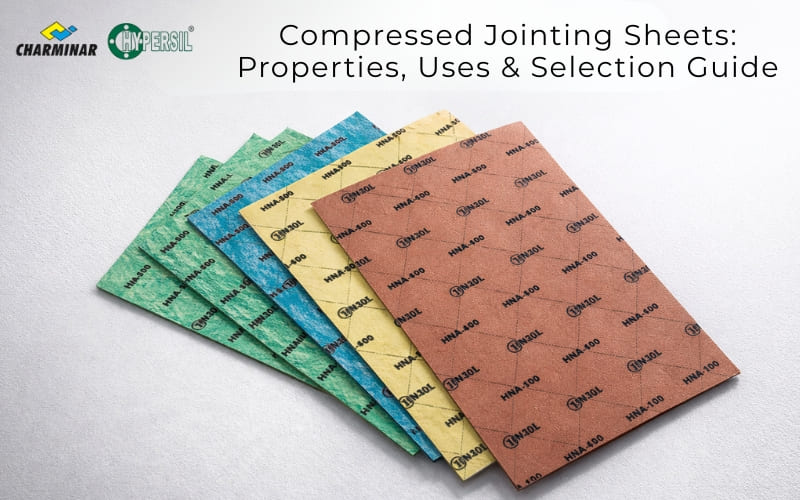

Industrial sealing systems demand materials that deliver reliable performance under extreme conditions. Whether you’re dealing with high-pressure steam lines, chemical reactors, or hydrocarbon pipelines, the right gasket sheet ensures leakage prevention, operational safety, and long service life. Compressed gasket jointing sheets are widely adopted for these reasons. Among them, Charminar’s HNA Series stands out as a benchmark for performance, durability, and versatility.
In this guide, we explore the science behind compressed jointing sheets, the full spectrum of HNA grades offered by Charminar, and the critical benefits that make them a preferred choice across high-stakes applications.
What Are Compressed Gasket Jointing Sheets?
Compressed gasket jointing sheets are sealing materials manufactured by blending high-strength fibres, fillers, and elastomer binders, then compressing them under heat and pressure. The result is a dense, homogeneous sheet that can deliver a tight seal under flange load, thermal cycling, and chemical exposure.
Key attributes of these sheets include:
- Non-asbestos composition: Modern compressed fibre gasket sheets avoid the health risks of asbestos by using safer fibres such as aramid and mineral fibres.
- Excellent compressibility and recovery: These materials can conform to flange surfaces under load and recover when the load is released, maintaining a tight seal.
- Broad media compatibility: From steam and water to hydrocarbons and mild acids, compressed jointing sheets resist a variety of process fluids.
- Long-term stability: They maintain dimensional integrity and do not degrade easily under thermal or mechanical stress.
These features make compressed jointing sheets an essential part of industrial gasket design, particularly for applications requiring consistent sealing performance over long durations.
Manufacturing Process
Understanding how compressed gasket jointing sheets are made helps explain why they perform so reliably:
- Raw Material Selection: Aramid fibre, mineral fibre, cellulosic fibre, and fillers are selected for their mechanical and sealing properties.
- Binder Integration: An elastomer binder like NBR (Nitrile Butadiene Rubber) is added to provide resilience, media resistance, and flexibility.
- Mixing and Rolling: The fibres, fillers, and binder are thoroughly mixed and then formed into a mat or sheet.
- Compression and Curing: The mixture is placed into a hot press, where it is compressed under high pressure and heat to form a uniform, dense sheet.
- Inspection and Testing: Finished sheets are tested for parameters like compressibility, recovery, tensile strength, and chemical compatibility.
This process produces a high-performance non-asbestos gasket material that can reliably maintain seal integrity across demanding operations.
Performance Advantages of Compressed Jointing Sheets
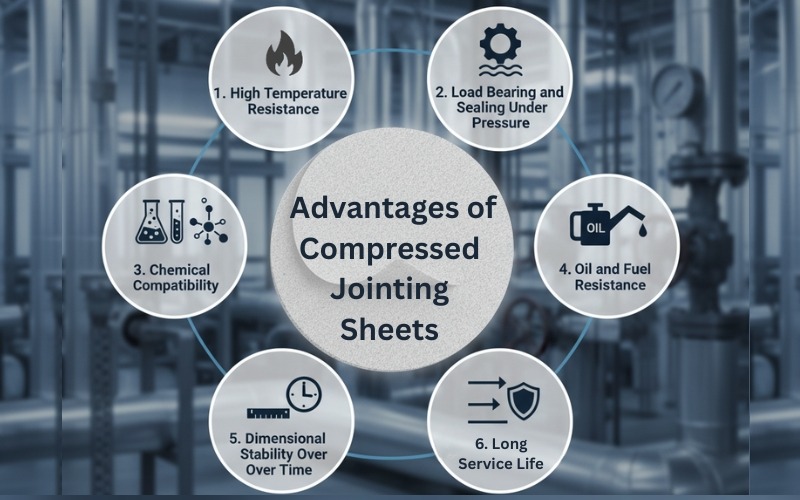
Here are the major reasons why compressed gasket jointing sheets are widely preferred in industrial sealing systems:
1. High Temperature Resistance
Compressed jointing sheets can withstand elevated temperatures. Depending on the grade, certain sheets can be used in steam lines or heat exchangers without significant degradation, which makes them ideal for industrial flange sealing in thermal systems.
2. Load Bearing and Sealing Under Pressure
Because of their density and construction, compressed fibre sheets maintain their shape and seal even under high pressure. Their gasket sheet pressure rating makes them reliable for pressure vessels, high-pressure flanges, and critical pipeline connections.
3. Chemical Compatibility
These sheets are engineered to resist a variety of media, oils, solvents, mild acids, water, and steam. This broad chemical resistance makes them well-suited for aggressive processing environments like refineries or chemical plants.
4. Oil and Fuel Resistance
Thanks to the NBR binder, compressed sheets perform exceptionally well in hydrocarbon environments. Their oil-resistant gasket sheet material helps prevent swelling, deterioration, or seal failure when exposed to fuels, oils, and lubricants.
5. Dimensional Stability Over Time
Unlike rubber gaskets that may creep or lose shape, compressed fibre sheets retain their integrity. Their structure ensures minimal deformation, even under cyclic thermal loads or repeated flange suspensions.
6. Long Service Life
Because of their robust mechanical and thermal properties, compressed jointing sheets often outlast less durable materials. This longevity translates into lower maintenance and reduced downtime, helping improve overall system reliability.
Charminar HNA Series: Complete Product Line
Charminar offers an extensive HNA Series of compressed gasket jointing sheets to cater to different industrial sealing requirements. Here is a detailed look at each of the eight grades listed on their website:
HNA 200 CJ – NSF Certified
- Designed for hygienic and potable-water systems
- Meets NSF certification standards, making it suitable for potable and food-grade applications
- Provides reliable sealing in water lines, light steam, and non-aggressive media
HNA-100
- General-purpose compressed gasket sheet
- Balanced for pressure, temperature, and chemical resistance
- Suitable for oils, steam, water, and mild industrial chemicals
HNA-200 – Lloyd’s Register Marine
- Certified by Lloyd’s Register for marine applications
- Excellent resistance to hydrocarbons, oils, and grease
- Designed for marine engines, ship piping, and offshore structures
HNA-300
- High-performance grade for elevated temperature environments
- Reinforced with high-strength fibre for superior mechanical integrity
- Ideal for boilers, steam lines, and power-plant systems where temperature is critical
HNA-400
- Engineered for combined high temperature and pressure environments
- Good resistance against solvents, gases, alkalis, and mild acids
- Used in process industries like petrochemicals and fertilizers
HNA-600
- Heavy-duty compressed sheet combining aramid fibre, glass fibre, and NBR
- Outstanding resilience, compressibility, and tensile strength
- Designed for highly demanding service in pressure vessels, large flanges, and corrosive environments
HNA-700
- Premium-grade aramid-based sheet
- Delivers excellent compressive recovery and stability under sustained loads
- Suitable for applications in refineries, steam-gas systems, and power plants
HNA-ACID
- Specifically formulated for acidic and corrosive media
- Highly resistant to strong acids and aggressive chemicals
- Ideal for acid transfer pipelines, chemical process equipment, and storage vessels
Key Benefits of the HNA Series

By selecting from the HNA Series, you get several clear advantages:
- Wide Application Coverage: From potable water (HNA 200 CJ) to acids (HNA-ACID) and marine systems (HNA-200 LR), there is a sheet tailored for every need.
- Safety and Compliance: Non-asbestos construction ensures regulatory and environmental compliance.
- High Reliability Under Stress: Whether dealing with high temperature, high pressure, or fluctuating loads, the sheets maintain integrity.
- Reduced Maintenance Costs: Long service life reduces the frequency of gasket replacement, minimizing downtime and operational costs.
- Customizability: Charminar can supply different thicknesses and sheet sizes to match specific flange dimensions and bolting patterns.
How to Select the Right HNA Grade
Choosing the right sheet from the HNA Series starts with understanding your system’s requirements. Here is a step-by-step guide:
- Define Operating Conditions
- What is the maximum continuous and peak temperature?
- What pressure will the flange or pipeline see?
- Identify the Process Fluid
- Is it water, steam, oil, gas, acid, or mixed media?
- Does it have any particulates or aggressive reagents?
- Evaluate Flange Design
- Flange rating, bolt pattern, and surface finish matter for compressibility and sealing.
- Do you require a thicker sheet or standard thickness?
- Match with HNA Grade
- Use HNA 200 CJ for potable/water lines.
- Use HNA-200 LR for marine.
- Use HNA-300 or 400 for high-temperature steam or process.
- Use HNA-600 or 700 for heavy load or aggressive media.
- Use HNA-ACID for acid or highly corrosive fluids.
- Installation & Maintenance Considerations
- Ensure proper torque-tightening sequence.
- Inspect the flange surfaces and ensure they are clean and flat.
- Maintain periodic checks for creep, recovery, or any signs of seal aging.
Installation Best Practices
Even the best gasket can fail if installed incorrectly. To ensure maximum performance from compressed jointing sheets:
- Clean flange surfaces thoroughly; remove rust, old gasket residues, and debris.
- Use the correct bolt tightening sequence, typically a cross or star pattern to distribute load evenly.
- Avoid over-tightening which can compress the sheet too much and damage its structure.
- If possible, use a torque wrench calibrated to the flange specification.
- After installation, periodically inspect for signs of creep, chemical degradation, or seal fatigue.
- Replace the gasket sheet when recovery or seal quality is compromised; waiting too long can lead to leaks or failure.
Frequently Asked Questions (FAQs)
1. What are compressed gasket jointing sheets used for?
Compressed gasket jointing sheets are used to seal flanges, pipelines, valves, boilers, and pressure vessels in industries handling steam, water, oils, chemicals, and gases. They help prevent leakage and maintain operational safety under varying temperature and pressure.
2. How is the HNA Series different from regular compressed jointing sheets?
The HNA Series is engineered with high-quality fibres and NBR binders, giving it superior temperature resistance, pressure handling, and chemical compatibility. Each HNA grade (100, 200, 300, 400, 600, 700, ACID, 200 CJ) is optimized for a specific application, making it more reliable than generic sheets.
3. Which HNA grade is best for high-temperature steam applications?
For high-temperature or steam service, HNA-300 and HNA-400 are recommended due to their enhanced heat stability and mechanical strength.
4. Which HNA sheet should be used for corrosive or acidic media?
For acidic or chemically aggressive environments, HNA-ACID is the most suitable grade because it is formulated to resist acid attack and corrosion.
5. Is there a certified HNA sheet for potable or drinking water applications?
Yes. HNA 200 CJ is NSF-certified and specifically designed for potable water, food-grade processing, and hygienic applications.
Final Thoughts
Sealing failures can cause significant safety risks, unplanned downtime, and high maintenance costs. Compressed gasket jointing sheets are a dependable solution, and Charminar’s HNA Series offers a well-engineered, application-specific range of products that meets the needs of diverse industrial sectors.
From the NSF-certified HNA 200 CJ for water systems to the corrosion-resistant HNA-ACID, each grade is crafted with precision to provide high performance, long service life, and regulatory compliance. With proper grade selection and installation, these sheets optimize sealing integrity, minimize leakage, and enhance operational safety.
Compared to traditional beater addition jointing sheets, compressed gasket sheets, especially the Charminar HNA Series, provide far better sealing performance, longevity, and safety across demanding industrial applications.
To explore which HNA jointing sheet best suits your needs, reach out to Charminar Jointing’s technical team for guidance, datasheets, and custom solutions tailored to your flange and media specifications.