
Industrial buyers rarely judge a sealing sheet by appearance alone. Two sheets may look identical, yet come from different production lots, use different formulations, or carry different inspection histories. When a pump manufacturer, maintenance contractor, or original equipment manufacturer needs repeatable quality, the paperwork accompanying the material becomes almost as important as the material itself. For purchasing teams, gasket material batch traceability starts with defining what evidence the order actually needs.
Gasket material batch traceability connects an identifiable sheet or roll to the records that describe its origin, testing, release, and movement through the supply chain. It does not guarantee perfect sealing performance. Instead, it gives purchasers a practical way to verify what arrived, compare it with purchase requirements, and investigate a concern without treating every delivery as suspect.
What Is Gasket Material Batch Traceability?
In simple terms, gasket material batch traceability means being able to move backwards from a received sheet, roll, or finished gasket to its identified manufacturing lot, and forwards from that lot to the customers or jobs that received it. The level of detail depends on the supplier’s system and the buyer’s agreement. A written definition of gasket material batch traceability prevents confusion between batch-level and individual-sheet identification.
A batch or lot number is the link. It may appear on packaging, dispatch documentation, a material label, or a certificate. A useful system links that number with the product grade, thickness, manufacturing date or period, inspection results, quantity, and shipment details. Records should remain readable and retrievable after the goods have left the warehouse. In day-to-day operations, gasket material batch traceability depends on consistent references rather than complicated numbering.
For a general explanation of how identifiers support this process, see the independent Wikipedia entry on lot numbers. The important lesson for buyers is that a code only helps when the supplier can explain which records it represents.
Why Gasket Material Batch Traceability Matters to Industrial Buyers
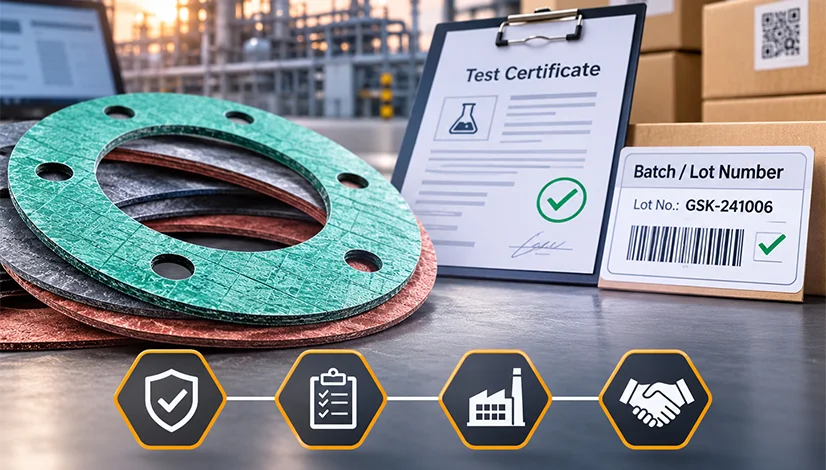
Consider an OEM assembling industrial pumps with non-asbestos gasket sheets. If the production team later detects an unusual dimensional variation, it needs to know whether the concern affects one delivery, one lot, or several purchase orders. Without gasket material batch traceability, staff may have to segregate all visually similar stock until the source is understood. This is where gasket material batch traceability becomes a practical production-control tool.
With records in place, the team can isolate a defined quantity, review the applicable inspection evidence, and ask targeted questions. That reduces avoidable disruption and makes communication between procurement, stores, quality assurance, and production more precise. Strong gasket material batch traceability narrows the investigation to evidence instead of assumptions.
Gasket material batch traceability is also valuable when a project has formal documentation requirements, when several thicknesses of the same grade are used, or when materials are supplied through distributors. It supports accountability, but it never replaces correct gasket design, suitable operating conditions, or installation controls.
Test Certificates: What They Show and What They Do Not
A material test certificate may report measured properties such as density, tensile strength, compressibility, recovery, or sealability. The specific properties and methods depend on the material, specification, and scope of testing. A product datasheet, by contrast, generally describes typical or specified performance and should not automatically be treated as an individual lot test result. Under gasket material batch traceability, the report should be tied to the material it is intended to represent.
When reviewing documents for gasket material batch traceability, check whether the report clearly identifies the material grade, batch or sample reference, thickness where relevant, test method, units, result, acceptance criterion, test date, and approving authority. Not every purchaser needs every test, and not every test applies to every sheet formulation. The value of gasket material batch traceability rises when acceptance criteria are unambiguous.
A certificate of analysis can include identification, methodology, and reported findings, as explained by Wikipedia’s certificate of analysis overview. Buyers should establish whether a supplied document is lot-specific, based on periodic testing, or simply a standard technical specification.
Gasket material batch traceability therefore works best when the purchase order names the documentation required. Never assume that a marketing claim, an undated datasheet, or a supplier’s general quality statement is a certificate for the material actually shipped.
Lot Numbers: The Practical Backbone of Gasket Material Batch Traceability
A good lot identifier should be unique within the supplier’s defined system and should survive ordinary receiving and handling. It does not have to follow a universal pattern. What matters is consistent use across labels, dispatch documents, records, and any certificates supplied. A reliable gasket material batch traceability process should also explain how replacement labels are issued.
For example, a fictional code such as GS-26-104 could point to one production lot. That code is illustrative, not an actual Charminar Jointings batch number. The receiving team should be able to match it to the delivery note and record it against the internal material-receipt entry.
If a warehouse divides a roll into smaller pieces, gasket material batch traceability can break down unless the new packages retain the original identifier. Internal stock labels, cutting-job cards, and records of partial issues help preserve the connection even when the original wrapper is discarded. This often-overlooked step protects gasket material batch traceability after the initial delivery.
How to Check Gasket Material Batch Traceability at Goods Receipt
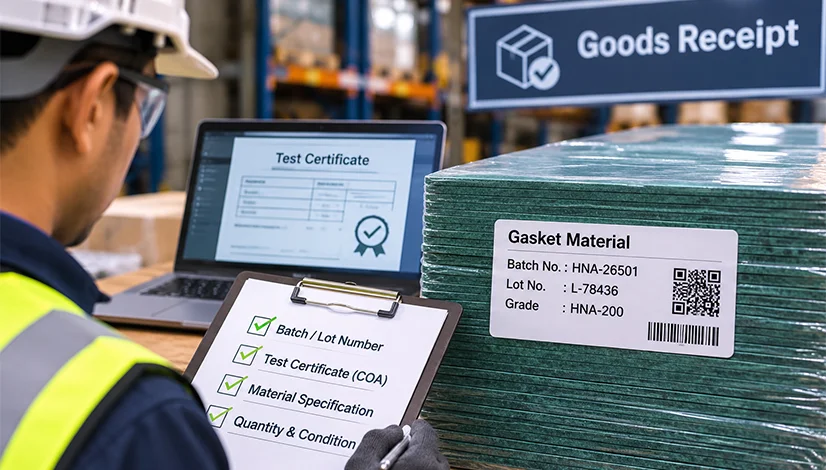
Before moving sheets to unrestricted stock, check the grade and thickness against the purchase order, compare quantities, photograph or record package identifiers, and confirm that the certificate references the delivered lot where one was requested. Any mismatch should be clarified before release. The receiving check is the buyer’s first opportunity to confirm gasket material batch traceability.
For multi-lot consignments, record quantities separately by lot. A single delivery note covering several lots does not mean that all of those lots share identical test results. Gasket material batch traceability depends on maintaining that distinction.
Quality Records Beyond the Certificate
Certificates are only one part of an effective quality trail. Inspection records, approved specifications, nonconformance reports, supplier correspondence, storage details, and dispatch records may also become important. Together, these documents explain what was checked, who made a decision, and how a particular delivery was handled. Effective gasket material batch traceability therefore combines documents with responsible recordkeeping.
For gasket material batch traceability, purchasing teams should agree on a reasonable record-retention period according to their project, customer, and regulatory requirements. There is no universal retention period suitable for every industrial gasket application.
Controlled revisions matter as well. If a product specification changes, buyers need a way to distinguish old and new revisions rather than assuming that every lot follows the latest downloadable sheet. A clear revision reference can prevent disagreements during incoming inspection. Version control keeps gasket material batch traceability meaningful when requirements evolve.
Using Gasket Material Batch Traceability in Supplier Evaluation
Good supplier assessment goes beyond asking whether certificates exist. Buyers should ask how lots are defined, which tests are performed, how samples are selected, how records are approved, and whether the supplier can retrieve an old shipment using a lot code or invoice reference. Ask for a specific example of gasket material batch traceability, not a general assurance.
For gasket material batch traceability, a simple mock exercise is revealing: choose a recently received package and ask the supplier to explain its documented route to manufacturing and testing records. A confident answer supported by consistent identifiers is more useful than a large collection of unrelated PDFs.
Industrial purchasers comparing grades can browse the Charminar Jointings product catalogue and review its non-asbestos jointing sheets before deciding which product specifications and document requirements to discuss with the sales team.
Common Documentation Mistakes Buyers Should Avoid
One frequent problem is accepting a datasheet as if it were proof of lot acceptance. Another is filing certificates by supplier name without recording the delivery or batch reference. Both create unnecessary work when a complaint arises months later. Maintaining gasket material batch traceability requires filing the evidence with the correct lot.
Gasket material batch traceability can also fail when multiple lot labels are mixed in one storage rack, cutting subcontractors do not carry identifiers forward, or records are saved under inconsistent filenames. A simple naming convention—supplier, grade, lot, receipt date—often makes retrieval much easier. Simple shop-floor habits can strengthen gasket material batch traceability across internal handoffs.
Another mistake is relying on the existence of records while ignoring material suitability. Even a perfectly documented lot may be unsuitable for a particular medium, pressure, temperature, flange arrangement, or installation method. Traceability and engineering approval solve different problems.
A Practical Gasket Material Batch Traceability Checklist
Before finalizing a purchase, confirm the following with your manufacturer or distributor: Use the checklist to define gasket material batch traceability expectations before shipment.
- The exact product grade, nominal thickness, and agreed technical specification are identified.
- Each delivered lot has an identifiable label or accompanying reference.
- Any requested certificate states its scope, tests, methods, and applicable lot or sample.
- The delivery note or invoice can be linked to the lot and received quantity.
- Mixed lots can be separated during storage, cutting, and production issue.
- Nonconforming material can be isolated while the supplier investigates.
- Records can be retrieved within a mutually agreed timeframe.
This checklist makes gasket material batch traceability actionable without imposing unnecessary paperwork on low-risk purchases. More critical applications may require additional documented controls defined by the customer or applicable specifications.
How Digital Records Improve Gasket Material Batch Traceability
Spreadsheets, warehouse-management software, and enterprise resource planning systems can link the purchase order, receipt, supplier lot, inspection decision, and production consumption. A barcode or QR code may speed up entry, but it is not a substitute for complete underlying records. Digitization can support gasket material batch traceability but cannot repair missing source information.
Small buyers can start with a structured receiving register and secure folders. The essential practices are controlled access, regular backups, clear filenames, and a way to correct mistakes without losing the original history. Gasket material batch traceability becomes useful when employees can retrieve the right evidence quickly, not simply when they purchase expensive software.
Questions to Ask Before Ordering Industrial Gasket Sheets
Ask whether lot identification is available on the packaging, which test documents can be supplied, whether documents are lot-specific, and how specification revisions are controlled. Also ask how disputes, re-testing, or investigation requests are handled. Confirm these arrangements in writing before ordering, especially for repeat OEM programs. A clear RFQ makes gasket material batch traceability requirements easier for both parties to meet.
Charminar Jointings describes its broader approach to testing and inspection on its customer and quality page. To discuss product requirements or request clarification about documentation available for a particular grade or order, use the company’s contact page. Documentation availability should always be confirmed rather than presumed.
Conclusion: Build Confidence Through Gasket Material Batch Traceability
Industrial sealing procurement involves technical decisions, delivery deadlines, and accountability. Gasket material batch traceability helps link those decisions to identifiable goods and supporting evidence. Clear lot labels, appropriate test documentation, disciplined receiving records, and practical supplier communication can all reduce uncertainty. Ultimately, gasket material batch traceability is valuable because it turns scattered facts into an accessible record.
The goal is not paperwork for its own sake. It is to make questions easier to answer: Which material arrived? Which lot did it belong to? What was checked? Where was it used? When those answers are available, industrial buyers can assess concerns with greater speed and confidence while maintaining the separate engineering checks required for safe, reliable sealing.